 info@cornerstonepowersolutions.com





Often it does not. A typical home Level 2 charger draws up to 30 amps and needs its own 40-amp circuit, and plenty of McKinney houses can carry that without touching the service. The honest answer for your house comes from a load calculation, not from the age of the panel or how full it looks when you open the door.
TL;DR
An EV charger panel upgrade is only needed when a load calculation shows the home’s electrical service cannot carry the charger on top of everything else already running. The U.S. Department of Energy says most residential Level 2 chargers run at up to 30 amps (7.2 kW) on a dedicated 40-amp circuit under Article 625 of the National Electrical Code, which treats EV charging as a continuous load. If the numbers fall short, the options are a lower charger setting, Level 1 charging on a dedicated outlet, or a service change that the electric utility has a say in. In McKinney, a new 240-volt circuit is new wiring, so it goes through the city’s permit portal as Residential Stand-Alone Electric. The federal 30C home charger credit ended for anything placed in service after June 30, 2026.
What Decides Whether a Panel Can Carry a Charger?
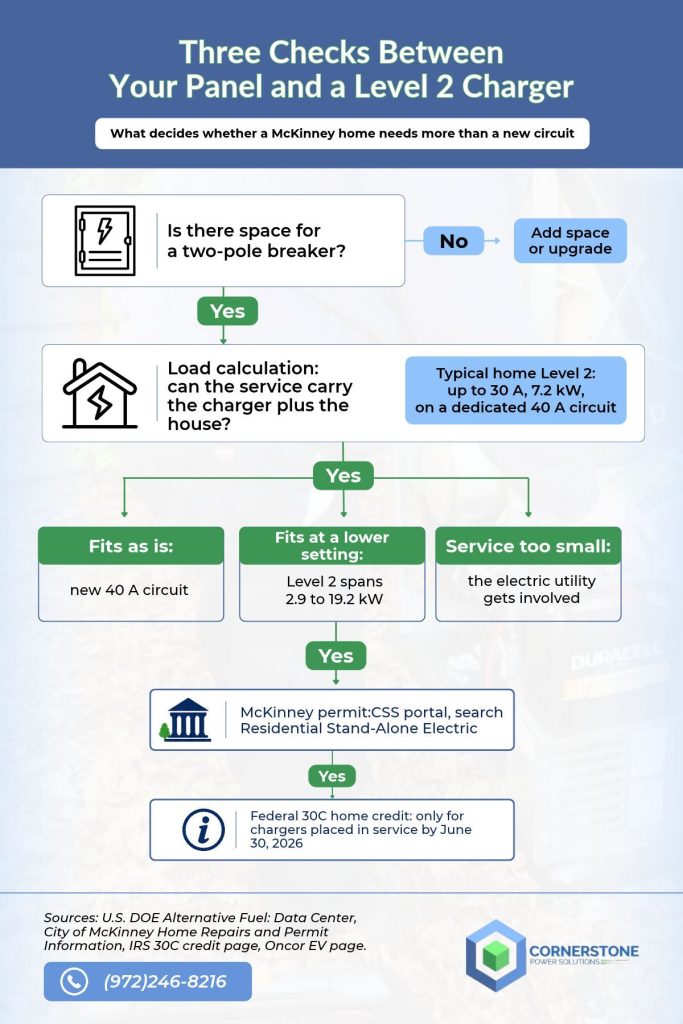
Two separate questions decide it, and people tend to blur them together. The first is physical: is there room in the panel for a two-pole breaker? The second is capacity: can the home’s electrical service supply the charger’s full draw, for hours, while the air conditioning, the oven, and the dryer are also running? A panel can pass the first test and fail the second, or the other way around.
The Department of Energy’s Alternative Fuels Data Center puts it plainly on its home charging guidance from the Alternative Fuels Data Center: electricians can tell homeowners whether the house has enough capacity, and “Some homes might have insufficient electric capacity for Level 2 equipment.” The same guide says a qualified electrician can add circuits to make room for Level 2 charging. That is the normal outcome, and it is a long way from a new service.
| Check | What it answers | How it is found |
|---|---|---|
| Breaker space | Is there a slot for a two-pole breaker? | Opening the panel and looking |
| Service capacity | Can the service carry the charger plus the house? | A load calculation on paper |
| Wire route | How far is the panel from where the car parks? | Walking the route from panel to garage |
| Permit path | Does the city need to see the work? | The city’s own permit rules |
A full panel is not proof that the service is too small. A half-empty panel is not proof that it is big enough. Only the calculation answers the capacity question.
The Numbers Behind a 40 Amp Charger Circuit
The figures that drive the whole conversation come from the Alternative Fuels Data Center’s figures for Level 1 and Level 2 charging equipment. It says most residential Level 2 chargers operate at up to 30 amps, delivering 7.2 kW, and that these units “require a dedicated 40-Amp circuit” to comply with Article 625 of the National Electrical Code.
Why a 40-amp circuit for a 30-amp charger? The home charging guide explains that the code treats EV charging as a continuous load, meaning it can run at full output for hours at a time. Circuits feeding continuous loads are sized with headroom above the draw, which is where the gap between 30 and 40 comes from.
That long, steady draw is what makes a charger different from most things in a house. A dryer runs for an hour. A charger can run all night.
Some plain arithmetic shows the scale. A 7.2 kW charger running for eight hours overnight moves about 57.6 kWh through the panel, and it does that at the same full rate from the first minute to the last.
Not every charger has to run at full output
The stations page also says a Level 2 unit can range from 2.9 to 19.2 kW of power output. So the 30-amp, 7.2 kW figure is a common setup, not the only one. A house that comes up short on a load calculation at full output may still have room for a charger set to draw less, at the cost of slower charging.
Level 1 is a real answer for some drivers
The same pages say many EV owners cover their daily driving with Level 1 charging, which uses the cordset that comes with the car on a 120 volt outlet. AFDC’s example is that eight hours of charging at 120 V replenishes about 40 miles of range for a mid-size EV. The catch, per the home charging guide, is that the outlet should be on a dedicated branch circuit near where the car parks.
If your commute in and out of McKinney is short and the car sits in the garage every night, Level 1 might be enough for now. We would rather tell you that than sell you a circuit you do not need.
How a Load Calculation Works on a Real House
A load calculation is the electrician adding up what the house already asks of its service, then adding the charger at its rated draw, and comparing the total with what the service is rated to supply. Article 625 governs the charger itself. The service side is about whether the house as a whole has the headroom.
On a North Texas house, the big entries are usually the same ones: the air conditioning, electric cooking, an electric dryer, and electric water heating if the home has it. A house with gas cooking, gas heat, and a gas water heater often has more room than its panel size suggests. An all-electric house of the same size may have far less.
Here is what we look at when we evaluate a home for a charger:
- The rating of the main breaker and the service it protects
- The large appliances on the panel schedule, and which ones are gas or electric
- Any existing large loads added since the house was built, such as a pool pump or a hot tub
- The distance and route from the panel to the parking spot
- Whether the charger will sit indoors or outdoors (the home charging guide says outdoor installations need outdoor-rated equipment)
- Any standby generator or transfer switch already tied into the panel
That last item matters more than people expect, and it gets its own section below.
The result of the calculation is a number, and it should be written down. If an installer tells you the panel is fine, or that it needs replacing, without being able to show the arithmetic behind that call, ask for it.
Three Outcomes After the Numbers Are Run
Every load calculation lands in one of three places. Knowing them in advance makes a quote much easier to read.
The service carries the charger as is
This is the common case. A two-pole breaker goes into an open space, a 40-amp circuit runs to the garage, and the charger is mounted and tested. No service change, no utility involvement beyond the bill.
The service carries a smaller charger
The calculation comes up a little short at 7.2 kW but has room at a lower setting. Because Level 2 equipment spans 2.9 to 19.2 kW, a lower setting is a legitimate design choice, not a workaround. For a driver who parks overnight, slower charging often still fills the battery by morning.
The service needs more than the panel can give
Sometimes the house simply has no headroom. At that point the question is no longer about breakers. It becomes a question about the service coming into the house, which involves the utility’s equipment as well as the homeowner’s.
| Outcome | What changes | Who is involved |
|---|---|---|
| Fits as is | New 40 amp circuit | Electrician, city inspector |
| Fits at a lower setting | Smaller breaker, slower charging | Electrician, city inspector |
| Service too small | The service itself | Electrician, city, and the electric utility |
Ask any installer, us included, which of the three your house falls into before you compare prices. Two quotes built on different outcomes are not comparable at all.
How McKinney Permits a New Charger Circuit
In McKinney, adding a Level 2 charger circuit is permitted work. The City of McKinney home repairs and permit rules list “Replacing plugs, switches and breakers with no changes to wiring” as work that does not need a permit. A new 240-volt circuit from the panel to the garage is a change to the wiring, so it falls outside that exemption.
The same guide sends electrical work through the city’s Citizen Self-Service (CSS) portal. You log in, use the Application Assistant search bar, and enter “Residential Stand-Alone Electric” to start. The city also offers a Development Navigation Assistant for a step-by-step walk-through of a project.
Who checks the work? The Texas Department of Licensing and Regulation’s electrician compliance guide from TDLR says the local licensing or inspecting authority, meaning the city, is responsible for inspecting work in its area, and that TDLR does not perform those inspections. The same guide says the state has adopted the 2023 edition of the National Electrical Code, effective September 1, 2023, and it points to “your local licensing or inspecting authority” for technical requirements that may be unique to a jurisdiction.
Frisco, Prosper, Celina, and Plano run their own process
Each city sets its own permit path and fees. We do not assume that McKinney’s categories carry over to Frisco, Prosper, Celina, or Plano, and you should not either. Whoever installs your charger should be able to name the permit they are pulling and which city is inspecting it.
Licensing is a state rule, not a local one
TDLR’s electrician FAQ is direct: anyone who performs electrical work in Texas must be licensed. TDLR also runs a public license search on its site, so you can check an installer’s license yourself in a couple of minutes.
Where Oncor Comes Into a Charger Project
For most panel questions, the utility never hears about it. The utility only becomes part of the conversation when the load calculation says the service itself is too small, because the service connects your panel to equipment the utility controls.
Oncor says so in its Oncor guidance on EV charging and service upgrades: “An EV project may mean increased electric usage at your home or business. Oncor can help you better understand if your location will need an upgrade.” It sends customers to its New Construction Portal to start that process.
Not every home in Collin County is on Oncor’s wires. Oncor’s existing service page tells customers to look up their ESI ID, which shows whether a location is inside Oncor’s territory. If your home is served by a different utility, that utility runs its own process for service changes.
One more Texas wrinkle: in much of the state, the company that sends your bill is a retail provider, and the company that owns the poles and wires is a separate delivery utility. A service change goes to the delivery utility, not to whoever you buy your plan from.
Can a Standby Generator Run an EV Charger in an Outage?
It can, if the generator was sized for it or the charger is kept off the generator while the grid is down. A charger pulling 7.2 kW for hours is one of the largest loads a house can have, so a generator plan has to account for it one way or the other.
The deciding piece is the transfer switch that decides which circuits a generator carries. If the charger circuit sits on the generator side and nobody counted it in the sizing, the generator may be asked for more than it can give right when the house needs it most.
This works the other way too. If you already have a standby generator, adding a charger is a change to the plan the generator was sized around. Tell your installer about the generator before any charger work starts.
For most families, charging the car is not the storm priority; heat and refrigeration come first. Our guide to what a North Texas ice storm asks of a backup plan walks through those priorities.
Does the Federal Tax Credit Still Help in November 2026?
No. The IRS rules for the Alternative Fuel Vehicle Refueling Property Credit, last updated May 26, 2026, limit the home credit to property placed in service at a main home from January 1, 2023, to June 30, 2026. A charger installed in McKinney this month earns nothing from it. For anyone who installed before the cutoff, the IRS sets the credit at 30% of the cost, up to $1,000 per item, claimed on Form 8911, and the home had to sit in a low-income or non-urban census tract.
Budget without it. The Department of Energy notes that state and utility incentives may exist, so ask your utility before you sign.
Questions to Ask Before Anyone Quotes a Charger
These are the questions we would ask if we were the homeowner. A good installer answers every one of them without hesitating.
- Will you run a load calculation and show me the numbers?
- Which of the three outcomes does my house fall into?
- What amperage will the charger be set to, and what circuit will feed it?
- Is the charger indoors or outdoors, and is the equipment rated for that spot?
- Is the equipment safety certified? The home charging guide recommends certified products, such as ENERGY STAR units tested by a nationally recognized testing laboratory.
- Which permit are you pulling, in which city, and who calls for the inspection?
- What is your TDLR license number?
- If the service turns out too small, who talks to the utility, and what happens to my quote?
- Is there a standby generator or transfer switch on this panel, and how does the charger affect it?
While the panel cover is off, some homeowners also ask about surge protection fitted at the main panel, since it lives in the same place. It is a separate decision with its own price, so ask for it as its own line on the quote.
The gas side has a twin of this question. A standby generator can push a gas meter past what it was sized for, and our breakdown of how Atmos Energy sizes the gas meter for a generator covers that check.
When the answers point to a straightforward circuit, the next step is booking the work. Our EV charger installation visit starts with an evaluation of your electrical system before we recommend a charger setup.
Getting a Straight Panel Answer Before You Buy a Charger
Buy the charger after you know what your panel and service can carry, not before. A load calculation on your actual house tells you whether a 40-amp circuit fits, whether a lower setting makes more sense, or whether the service needs a conversation with the utility. McKinney’s permit portal, TDLR’s license search, and the utility’s own process each handle a piece of it.
We are a small, family-owned team working in McKinney, Frisco, Prosper, Celina, Plano and the towns around them. If you want the numbers for your house written down and explained, talk to Cornerstone Power Solutions and we will walk the panel with you.
